Showing posts with label NAME REACTIONS. Show all posts

Sunday, April 26, 2020

WILLIAMSON SYNTHESIS

Williamson Synthesis


This method is suitable for the preparation of a wide variety of unsymmetric ethers. The nucleophilic substitution of halides with alkoxides leads to the desired products.


If the halides are sterically demanding and there are accessible protons in the β-position, the alkoxide will act as a base, and side products derived from elimination are isolated instead.


Mechanism of the Williamson Synthesis


Saturday, April 25, 2020

OPPENAUER REACTION

Oppenauer Oxidation


The aluminium-catalyzed hydride shift from the α-carbon of an alcohol component to the carbonyl carbon of a second component, which proceeds over a six-membered transition state, is named Meerwein-Ponndorf-Verley-Reduction (MPV) or Oppenauer Oxidation (OPP) depending on the isolated product. If aldehydes or ketones are the desired products, the reaction is viewed as the Oppenauer Oxidation.

Non-enolizable ketones with a relatively low reduction potential, such as benzophenone, can serve as the carbonyl component used as the hydride acceptor in this oxidation.


Recent Literature


Oppenauer Oxidation of Secondary Alcohols with 1,1,1-Trifluoroacetone as Hydride Acceptor


Efficient and Selective Al-Catalyzed Alcohol Oxidation via Oppenauer Chemistry


Practical Oppenauer (OPP) Oxidation of Alcohols with a Modified Aluminium Catalyst


General Transition Metal-Free Synthesis of NH-Pyrroles from Secondary Alcohols and 2-Aminoalcohols

NEF REACTION

Nef Reaction


The conversion of nitro compounds into carbonyls is known as the Nef Reaction. Various methodologies have been developed, but the most important is the standard procedure: a preformed nitronate salt is poured into strong aqueous acid (pH < 1). Some oxidative variations have also found wide application, and some reductive methods have even been developed.


Mechanism of the Nef Reaction


Nitroalkanes are relatively strong carbon acids, and deprotonation leads to the nitronate salt. The hydrolysis of this intermediate must take place in strong acid, to prevent the formation of side products such as oximes or hydroxynitroso compounds:


The procedure using the commercial reagent Oxone® is mechanistically interesting:


The reductive method leads to oximes, which may be hydrolyzed to the corresponding carbonyl compound. Ti(III) serves to reduce the N-O bond, and titanium's strong affinity towards oxygen facilitates the hydrolysis to complete the conversion:


Recent Literature


Unprecedented, selective Nef reaction of secondary nitroalkanes promoted by DBU under basic homogeneous conditions


Silicon-Catalyzed Conversion of Nitro Compounds into Ketones and Poly(1,3-diketones)


KMnO4-Mediated Oxidation as a Continuous Flow Process


Cu-Catalyzed Enantioselective Conjugate Addition of Alkylzincs to Cyclic Nitroalkenes: Catalytic Asymmetric Synthesis of Cyclic α-Substituted Ketones


One-Pot Synthesis of γ-Diketones, γ-Keto Esters, and Conjugated Cyclopentenones from Nitroalkanes


Boron Trifluoride Mediated Ring-Opening Reactions of trans-2-Aryl-3-nitro-cyclopropane-1,1-dicarboxylates. Synthesis of Aroylmethylidene Malonates as Potential Building Blocks for Heterocycles

MITSUNOBU REACTION

Mitsunobu Reaction


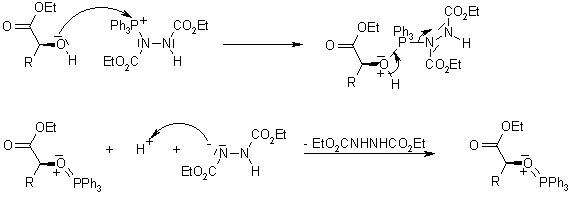
The Mitsunobu Reaction allows the conversion of primary and secondary alcohols to esters, phenyl ethers, thioethers and various other compounds. The nucleophile employed should be acidic, since one of the reagents (DEAD, diethylazodicarboxylate) must be protonated during the course of the reaction to prevent from side reactions.


Suitable nitrogen nucleophiles include phthalimide or hydrogen azide; subsequent hydrolysis (in the case of using phthalimide, see Gabriel Synthesis) or selective reduction (in the case of azide formation, see Staudinger Reaction) makes the corresponding amines accessible.


Mechanism of the Mitsunobu Reaction


The triphenylphosphine combines with DEAD to generate a phosphonium intermediate that binds to the alcohol oxygen, activating it as a leaving group. Substitution by the carboxylate, mercaptyl, or other nucleophile completes the process.


The reaction proceeds with clean inversion, which makes the Mitsunobu Reaction with secondary alcohols a powerful method for the inversion of stereogenic centers in natural product synthesis.


Side Reaction:


New protocols have been developed which allow better removal of side products and/or the conversion of more basic nucleophiles.


Recent Literature


Mitsunobu Reaction with 4-(Diphenylphosphino)benzoic Acid: A Separation-Friendly Bifunctional Reagent that Serves as Both a Reductant and a Pronucleophile


Easily Prepared Azopyridines As Potent and Recyclable Reagents for Facile Esterification Reactions. An Efficient Modified Mitsunobu Reaction


Systematic Evaluation of 2-Arylazocarboxylates and 2-Arylazocarboxamides as Mitsunobu Reagents


Simplification of the Mitsunobu Reaction. Di-p-chlorobenzyl Azodicarboxylate: A New Azodicarboxylate


Mitsunobu Approach to the Synthesis of Optically Active α,α-Disubstituted Amino Acids


One-Carbon Homologation of Primary Alcohols to Carboxylic Acids, Esters, and Amides via Mitsunobu Reactions with MAC Reagents


Fluorous Mitsunobu reagents and reactions


A convenient Two-Step Procedure for the Synthesis of Substituted Allylic Amines from Allylic Alcohols


Use of Sonication for the Coupling of Sterically Hindered Substrates in the Phenolic Mitsunobu Reaction


Organocatalytic Mitsunobu Reactions


Carbon Nucleophiles in the Mitsunobu Reaction. Mono and Dialkylation of Bis(2,2,2-trifluorethyl) Malonates


O-TBS-N-tosylhydroxylamine: A Reagent for Facile Conversion of Alcohols to Oximes


An Efficient, One-Pot Synthesis of S-Alkyl Thiocarbamates from the Corresponding Thiols Using the Mitsunobu Reagent


Synthesis of N-H vinylaziridines: a comparative study


Exploration of the Mitsunobu Reaction with Tosyl- and Boc-Hydrazones as Nucleophilic Agents


Single-Step Process for the Reductive Deoxygenation of Unhindered Alcohols


Conversion of Alcohols, Thiols, Carboxylic Acids, Trimethylsilyl Ethers, and Carboxylates to Thiocyanates with Triphenylphosphine/Diethylazodicarboxylate/NH4SCN


Successive Nucleophilic and Electrophilic Allylation for the Catalytic Enantioselective Synthesis of 2,4-Disubstituted Pyrrolidines


A Modular Synthesis of 2-Alkyl- and 2-Arylchromans via a Three-Step Sequence

MICHAEL ADDITION

Michael Addition


The 1,4-addition (or conjugate addition) of resonance-stabilized carbanions. The Michael Addition is thermodynamically controlled; the reaction donors are active methylenes such as malonates and nitroalkanes, and the acceptors are activated olefins such as α,β-unsaturated carbonyl compounds.
Examples:


donors


acceptors


Mechanism of the Michael Addition


Recent Literature


Ionic Liquid as Catalyst and Reaction Medium. The Dramatic Influence of a Task-Specific Ionic Liquid, [bmIm]OH, in Michael Addition of Active Methylene Compounds to Conjugated Ketones, Carboxylic Esters, and Nitriles


Diphenylprolinol Methyl Ether: A Highly Enantioselective Catalyst for Michael Addition of Aldehydes to Simple Enones


Consecutive Michael-Claisen Process for Cyclohexane-1,3-dione Derivative (CDD) Synthesis from Unsubstituted and Substituted Acetone


Construction of Quaternary Stereocenters by Efficient and Practical Conjugate Additions to α,β-Unsaturated Ketones with a Chiral Organic Catalyst


P-BEMP: A New Efficient and Commercially Available User-Friendly and Recyclable Heterogeneous Organocatalyst for the Michael Addition of 1,3-Dicarbonyl Compounds


An asymmetric direct Michael addition of α,β-unsaturated aldehydes with acetophenone catalyzed by a Jørgensen-Hayashi catalyst in methanol gave δ-keto aldehydes in up to 82% yield and 98% ee.


A new reactivity pattern for vinyl bromides: cine-substitution via palladium catalysed C-N coupling/Michael addition reactions


Highly Efficient Asymmetric Michael Addition of Aldehydes to Nitroalkenes Catalyzed by a Simple trans-4-Hydroxyprolylamide


Enantio- and Diastereoselective Michael Reaction of 1,3-Dicarbonyl Compounds to Nitroolefins Catalyzed by a Bifunctional Thiourea


A Novel Recyclable Organocatalytic System for the Highly Asymmetric Michael Addition of Aldehydes to Nitroolefins in Water


Importance of Chiral Phase-Transfer Catalysts with Dual Functions in Obtaining High Enantioselectivity in the Michael Reaction of Malonates and Chalcone Derivatives


Helical peptide foldamers catalyze Michael addition reactions of nitroalkanes or dialkyl malonates to α,β-unsaturated ketones to give Michael adducts with high enantioselectivities. The amide protons at the N terminus in the α-helical peptide catalyst are crucial for activating Michael donors, while the N-terminal primary amine activates Michael acceptors through the formation of iminium ion intermediates.


Highly Enantioselective Michael Addition of Nitroalkanes to Enones and Its Application in Syntheses of (R)-Baclofen and (R)-Phenibut


Highly Efficient C-C Bond-Forming Reactions in Aqueous Media Catalyzed by Monomeric Vanadate Species in an Apatite Framework


Expanding the Scope of Lewis Acid Catalysis in Water: Remarkable Ligand Acceleration of Aqueous Ytterbium Triflate Catalyzed Michael Addition Reactions


Reconstructed Hydrotalcite as a Highly Active Heterogeneous Base Catalyst for Carbon-Carbon Bond Formations in the Presence of Water


DABCO-Based Ionic Liquids: Recyclable Catalysts for Aza-Michael Addition of α,β-Unsaturated Amides under Solvent-Free Conditions


Silicon Tetrachloride Catalyzed Aza-Michael Addition of Amines to Conjugated Alkenes under Solvent-Free Conditions


Cellulose-Supported Copper(0) Catalyst for Aza-Michael Addition


Copper-Catalyzed Aza-Michael Addition of Aromatic Amines or Aromatic Aza-Heterocycles to α,β-Unsaturated Olefins


Ceric Ammonium Nitrate Catalyzed aza-Michael Addition of Aliphatic Amines to α,β-Unsaturated Carbonyl Compounds and Nitriles in Water


A Michael Addition-Asymmetric Transfer Hydrogenation One-Pot Enantioselective Tandem Process for Syntheses of Chiral γ-Secondary Amino Alcohols


Ethyl Glyoxylate N-Tosylhydrazone as Sulfonyl-Transfer Reagent in Base-Catalyzed Sulfa-Michael Reactions


Construction of 5,6-Ring-Fused 2-Pyridones: An Effective Annulation Tactic Achieved in Water

BIOMOLECULES CHEMISTRY CLASS 12

                           BIOMOLECULES ( CHEMISTRY )        Carbohydrates:  Polyhydroxy aldehydes or polyhydroxy ketones or compounds on hy...