Showing posts with label CHEMISTRY BASICS. Show all posts

Friday, May 8, 2020

LEWIS-DOT STRUCTURES

Lewis Structures

In many instances, only the valence electrons—also called the outer‐shell electrons or bonding electrons (because of their location in the atom and their reactivity)—are of interest to chemists. In such cases, it is advantageous to draw the Lewis structure of the atom or molecule. In a Lewis structure (also known as an electron dot structure), the entire atom, with the exception of the valence electrons, is represented by the symbol of the element, and the valence electrons are represented by dots. Thus, the Lewis structure of carbon ( Z = 6) is

The letter C, the symbol for carbon, represents the carbon nucleus of six protons and six neutrons and the two 1 s electrons. The four outer‐shell electrons, two 2 s and two 2 p electrons, are represented by the dots.


ATOMIC STRUCTURE

Atomic Structure

The concept of the atom was created by early Greek philosophers who believed that all matter was composed of indivisible particles. They called these particles atomos, meaning “uncuttable.” It wasn't until the early nineteenth century that John Dalton formulated a theory based on scientific investigation that characterized the nature of atoms. Further discoveries in the nineteenth and twentieth centuries led to the knowledge that atoms possess an internal structure of smaller subatomic particles.

Subatomic particles. The major subatomic particles were found to be protons, electrons, and neutrons. Protons are positively charged particles that have weight. Electrons are negatively charged particles of little weight, while neutrons are just slightly heavier than protons but have no charge. Investigations revealed that protons and neutrons are located in the central core, or nucleus, of the atom, while electrons exist outside of the nucleus in areas of high probability called orbits, or shells. Orbits are further divided into more precise regions of electron probability called orbitals, or subshells.

Niels Bohr proposed the concept of the solar‐system atom, in which the nucleus of the atom is like the sun and the electrons are like the planets, revolving in circular orbits. The farther an orbit is from the nucleus, the larger the orbit becomes and the more electrons it can hold.

Because all atoms are electrically neutral, the number of protons and electrons must be equal. Neutrons add weight but no charge to an atom, so additional neutrons do not change an element but merely convert it to one of its isotopic forms. The atomic number ( Zof an atom is equal to the number of protons in the nucleus or the number of electrons in its orbits. The atomic mass ( A) is equal to the sum of the protons and neutrons in the atom. (A proton and neutron each have a mass of 1 atomic mass unit, while an electron has virtually no mass.)

Atoms are capable of both losing and gaining electrons to achieve a stable state. If an atom loses one or more electrons, it becomes a positively charged ion called a cation. If an atom gains one or more electrons, it becomes a negatively charged ion called an anion. The charge on an ion is equal to the number of electrons lost or gained.

Orbits and orbitals. Electrons fill orbits in an organized fashion based on energy factors. The order of electron fill‐in, called the aufbau buildup, is 1 s, 2 s, 2 p, 3 s, 3 p, 4 s, …, where the numerals represent the principal quantum number of the orbit, and the lowercase letters represent the orbitals within a given orbit. The numbering begins with 1 for the orbit closest to the nucleus of the atom. The lower the orbit number, the smaller the orbit size and fewer electrons the orbit can hold.

The first principal orbit is large enough to hold just two electrons in an s orbital. The second principal orbit is large enough to contain one s and three p orbitals, while the third principal orbit, which is larger still, contains an s orbital, three p orbitals, and five d orbitals. When electrons are added to equivalent orbitals, which are orbitals of the same principal level and type, one electron must occupy each equivalent orbital before any of these orbitals can contain two electrons. Thus carbon, Z = 6, has six electrons distributed in these orbitals:

The orbitals can also be shown in the following fashion. In this diagram, the arrows represent electrons. Notice that single electrons are filling the 2 p orbitals one at a time and not pairing first in 2 x .

For two electrons to occupy the same orbital, they must have opposite spins, or paired spins, which generate orbital stability by creating opposite magnetic poles. Between equivalent orbitals, the spins of the electrons must be parallel, that is, spinning in the same direction, for the orbitals to be stable. Parallel spins create the same magnetic pole, causing repulsion between the orbitals. This repulsion gives the orbitals maximum separation and the greatest stability.

Orbitals within a given orbit have different shapes and sizes. The s orbitals are spherical, while the p orbitals are hourglass shaped. The s orbital is smaller than the p orbital. 

BOND RUPTURE AND FORMATION

Bond Rupture and Formation

Chemical reactions involve bond rupture and formation. In covalently bonded carbon molecules, for example, the bonds can be broken in two ways: symmetrically or asymmetrically. In a symmetrical rupture, each atom in the original covalent bond receives one electron. This type of rupture generates free radicals and is referred to as homolytic cleavage. In reactions, it generates free‐radical mechanisms.

Asymmetrical breaking of a single covalent bond leads to ion formation and is referred to as heterolytic cleavage. In reactions, it generates carbocation or carbanion mechanisms. (A carbocation is a carbon atom bearing a positive charge; a carbanion is a carbon atom bearing a negative charge.)

The reverse reactions produce either homogenic bond formation from free radicals or heterogenic bond formation from ions.

Thursday, May 7, 2020

REACTION MECHANISMS

Mechanisms

A mechanism is the series of steps that substances go through while changing from reactants to products. Each of the steps is a reaction. The step with the highest activation energy will normally be the slowest step, or rate‐determining step. When a mechanism has been determined and proven to be correct, it allows a scientist to explain how a reaction works and to make predictions.

An illustration of a mechanism is the production of cakes at a bakery. An equation for this operation simply shows the type and amount of ingredients that are delivered to the bakery and the number and kinds of cakes that leave the bakery.

The mechanism tracks each step in transforming the original ingredients into the final cakes.

  • flour, eggs, and water are mixed (10 minutes)
  • butter, sugar, and flavorings are added (1 minute)
  • batter is mixed to uniform consistency (5 minutes)
  • batter is put in pans and set in oven (20 minutes)
  • cakes are baked in oven (45 minutes)
  • cakes are removed from oven and cooled (15 minutes)
  • frosting is mixed (5 minutes)
  • cakes are hand frosted and decorated (60 minutes)

These eight steps compose the mechanism for the production of the finished cakes. The slowest step, the frosting and decorating of the cakes, is the rate‐determining step. If this frosting step could be modified to take less time, say, by machine decorating the cakes in thirty minutes, cake production would increase and a new rate‐determining step would be in operation. In this illustration, the baking process, which requires 45 minutes, would become the rate‐determining step.

BRONSTED-LOWRY AND LEWIS THEORY OF ACIDS AND BASES

Brønsted‐Lowry Theory of Acids and Bases

In the early twentieth century, S. Arrhenius defined an acid as a compound that liberates hydrogen ions and a base as a compound that liberates hydroxide ions. In his acid‐base theory, a neutralization is the reaction of a hydrogen ion with a hydroxide ion to form water.


The weakness of Arrhenius's theory is that it is limited to aqueous systems. A more general acid‐base theory was devised by Brønsted and Lowry a couple decades later. In their theory, an acid is any compound that can donate a proton (hydrogen ion). A base is similarly defined as any substance that can accept a proton. This definition broadened the category of bases. In a Brønsted‐Lowry neutralization, an acid donates a proton to a base. In the process, the original acidic molecule becomes a conjugate base; that is, it can accept a proton. Likewise, the base that accepted the proton becomes a conjugate acid, and it can donate a proton. Thus, in a Brønsted‐Lowry neutralization reaction, conjugate acid‐base pairs are generated.

The ability of a compound to liberate protons is a measure of its strength as an acid. For a compound to easily liberate a proton, its conjugate base must be weak. Similarly, a substance that liberates protons poorly must have a conjugate base that is strong. Thus, the conjugate bases of strong mineral acids are weak, while the conjugate bases of weak inorganic and organic acids are strong.

Lewis Theory of Acids and Bases

Both the Arrhenius and Brønsted‐Lowry theories of acids and bases define an acid as a hydrogen ion (proton) donor. In the Lewis theory, a base is any substance that can donate a pair of electrons to another compound. An acid then becomes any compound capable of accepting a pair of electrons from another substance. This theory greatly increases the number of chemicals considered to be acids and bases. For example, the reaction of boron trifluoride, BF 3, with dimethyl ether, CH 3OCH 3, is an acid‐base reaction.

COVALENT BOND AND ELECTRONEGATIVITY

Covalent Bonding and Electronegativity

Covalent bonds form when atoms share electrons. This sharing allows each atom to achieve its octet of electrons and greater stability. Methane, CH 4, the simplest organic compound, contains covalent bonds. Carbon has four valence electrons, while hydrogen has one valence electron. By sharing these outer‐shell electrons, carbon and hydrogen complete their valence shells and become more stable. The duet of electrons on the hydrogen is isoelectronic with helium and forms a complete shell.

Polarity of bonds.

 In a pure covalent bond, the shared electrons are equally available to each of the atoms. This arrangement occurs only when two atoms of the same element bond with each other. Thus, the hydrogen molecule, H 2, contains a good example of a pure covalent bond.

In most cases, the electrons in covalent bonds are not shared equally. Usually, one atom attracts the bonding electrons more strongly than does the other. This uneven attraction results in these electrons moving closer to the atom with the greater power of attraction. The resulting asymmetrical distribution of electrons makes one end of the molecule more electron rich, and it acquires a partial negative charge, while the less electron rich end acquires a partial positive charge. This difference in electron density causes the molecule to become polar, that is, to have a negative and a positive end.

The ability of an atom to attract electrons in a chemical bond is called the electronegativity of the atom. The electronegativity of an atom is related to its electron affinity and ionization energy. Electron affinity is the energy liberated by a gaseous atom when an electron is added to it. Ionization energy is the minimum amount of energy necessary to remove the most weakly bound electron from a gaseous atom.

Electronegativity level is normally measured on a scale that was created by Linus Pauling. On this scale, the more electronegative elements are the halogens, oxygen, nitrogen, and sulfur. Fluorine, a halogen, is the most electronegative with a value of 4.0, which is the highest value on the scale. The less electronegative elements are the alkali and alkaline earth metals. Of these, cesium and francium are the least electronegative at values of 0.7.

Elements with great differences in electronegativity tend to form ionic bonds. Atoms of elements with similar electronegativity tend to form covalent bonds. (Pure covalent bonds result when two atoms of the same electronegativity bond.) Intermediate differences in electronegativity between covalently bonded atoms lead to polarity in the bond. As a rule, an electronegativity difference of 2 or more on the Pauling scale between atoms leads to the formation of an ionic bond. A difference of less than 2 between atoms leads to covalent bond formation. The nearer the difference in electronegativity between atoms comes to zero, the purer the covalent bond becomes and the less polarity it has.

Carbon, with an electronegativity of 2.5, forms both low‐ and high‐polarity covalent bonds. The electronegativity values of elements commonly found in organic molecules are given in Table .


IONIC BONDS

Ionic Bonding

Ionic bonding occurs when electrons transfer between atoms, with a concurrent formation of ions. The electrostatic attraction between newly formed cations and anions is the heart of the ionic bond.

By losing and gaining electrons, both the sodium atom and the chlorine atom acquire stability by achieving an octet of valence electrons. An octet of electrons is eight electrons, the number found in the outermost level of the low‐atomic‐weight noble gases. Through the loss of an electron, sodium becomes isoelectronic (having the same number and configuration of electrons) with the inert gas neon. By gaining an electron, the chlorine atom becomes isoelectronic with the inert gas argon. Ionic bonds form mainly between atoms of groups IA and IIA and atoms of groups VIA and VIIA of the periodic table.

BENZENE

Benzene


In 1834, Eilhardt Mitscherlich conducted vapor density measurements on benzene. Based on data from these experiments, he determined the molecular formula of benzene to be C 66. This formula suggested that the benzene molecule should possess four modes of unsaturation because the saturated alkane with six carbon atoms would have a formula of C 614. These unsaturations could exist as double bonds, a ring formation, or a combination of both.
Structure of the benzene molecule
In 1866, August Kekulé used the principles of structural theory to postulate a structure for the benzene molecule. Kekulé based his postulation on the following premises:
  • The molecular formula for benzene is C 66.
  • All the carbons have four bonds as predicted by structural theory.
  • All the hydrogens are equivalent, meaning they are indistinguishable from each other.
Based on these assumptions, Kekulé postulated a structure that had six carbons forming a ring structure. The remaining three modes of unsaturation were the result of three double bonds alternating with three single bonds. This arrangement allowed all the carbon atoms to have four bonds as required by structural theory.
Scientists soon realized that if Kekulé's structure were correct, substituting substituent groups for hydrogens on the 1,2 positions would lead to a different compound than substitution on the 1,6 positions.
Because no such isomers could be produced experimentally, Kekulé was forced to modify his proposed structure. Kekulé theorized that two structures existed that differed only in the location of the double bonds. These two structures rapidly interconverted to each other by bond movement.
Although Kekulé's structure accounted for the modes of unsaturation in benzene, it did not account for benzene's reactivity.

Resonance

Modern instrumental studies confirm earlier experimental data that all the bonds in benzene are of equal length, approximately 1.40 pm. (A picometer equals 1 × 10 −12 meter.) This bond length falls exactly halfway between the length of a carbon‐carbon single bond (1.46 pm) and a carbon‐carbon double bond (1.34 pm). In addition, these studies confirm that all bond angles are equal (120°) and that the benzene molecule has a planar (flat) structure.

Modern descriptions of the benzene structure combine resonance theory with molecular orbital theory.
Resonance theory postulates that when more than one structure can be drawn for the same molecule, none of the drawn structures is the correct structure. The true structure is a hybrid of all the drawn structures and is more stable than any of them. The greater the number of structures that can be drawn for a molecule, the more stable the hybrid structure will be. The difference between the calculated energy for a drawn structure and the actual energy of the hybrid structure is called the resonance energy. The greater the resonance energy of a compound, the more stable the compound.
The two Kekulé structures that can be drawn for the benzene molecule are actually two resonance structures.
The hybrid of these structures would be drawn as
  
where the circle represents the movement of the electrons throughout the entire molecule. This delocalization of Ï€ electrons (electrons found in Ï€ molecular orbitals) is also found in conjugated diene systems. Like benzene, the conjugated diene systems show increased stability.
Because of resonance, the benzene molecule is more stable than its 1,3,5‐cyclohexatriene structure suggests. This extra stability (36 kcal/mole) is referred to as its resonance energy.

Orbital picture of benzene


Because experimental data shows that the benzene molecule is planar, that all carbon atoms bond to three other atoms, and that all bond angles are 120°, the benzene molecule must possess sp 2 hybridization. With sp 2 hybridization, each carbon atom has an unhybridized atomic p orbital associated with it. The overlap of the sp 2 hybrid orbitals would create the σ bonds that hold the ring together, while the side‐to‐side overlap of the atomic p orbitals can occur in both directions, leading to complete delocalization in the Ï€ system. This complete delocalization adds great stability to the molecule. Figure 1 illustrates this idea.
Molecular orbital theory predicts that overlapping six atomic p orbitals will lead to the generation of six π molecular orbitals. Three of these π molecular orbitals will be bonding orbitals, while the other three will be antibonding orbitals, as shown in Figure 2
The three low‐energy orbitals, denoted Ï€ 1, Ï€ 2, and Ï€ 3, are bonding combinations, and the three high‐energy orbitals, denoted Ï€ 4 *, Ï€ 5 *, and Ï€ 6 *, are antibonding orbitals. Two of the bonding orbitals (Ï€ 2 and Ï€ 3) have the same energy, as do the antibonding orbitals Ï€ 4 and Ï€ 5. Such orbitals are said to be degenerate.
Because the electrons are all located in bonding orbitals, the molecule is very stable. Additional stability occurs because all the bonding orbitals are filled and all the π electrons have paired spins. Molecules that possess all these characteristics are said to have a closed bond shell of delocalized π electrons. Molecules such as benzene that possess a closed bond shell of delocalized π electrons are extremely stable and show great resonance energies.

Tuesday, April 21, 2020

HYPERCONJUGATON EFFECT

Hyperconjugation - Electromeric effect

The electron displacement in an organic molecule may take place in the presence of an appropriate attacking reagent. This kind of electron displacements leads to polarization of the bond. Some of the effects are electromeric effect and hyperconjugation, which are explained below:

Electromeric effect:

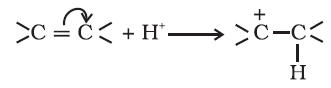
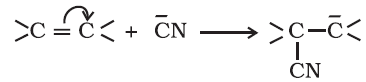
The electromeric effect is a temporary effect, mainly experienced in the presence of an attacking reagent in the vicinity of an organic compound having multiple bonds(a double or triple bond). In this effect, the complete transfer of a shared pair of π-electrons to one of the atoms joined by multiple bonds on the demand of an attacking reagent takes place. The effect ceases as soon as the attacking reagent is removed from the domain of the reaction. The electromeric effect is mainly categorized into two categories.
  1. Positive Electromeric Effect (+E effect):

    The positive electromeric effect is defined as the transfer of Ï€−electrons of the multiple bonds to the atom with which the reagent gets attached.
Positive Electromeric Effect
  1. Negative Electromeric Effect (–E effect):

    The positive electromeric effect is defined as the transfer of Ï€−electrons of the multiple bonds to the atom with which the reagent does not get attached.
Negative Electromeric Effect

Hyperconjugation:

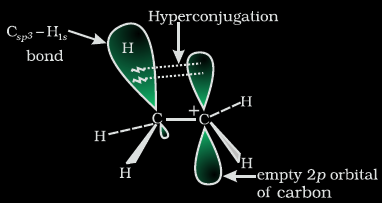
Hyperconjugation effect is a permanent effect in which localization of σ electrons of C-H bond of an alkyl group directly attached to an atom of the unsaturated system or to an atom with an unshared p orbital takes place.
Hyperconjugation
Hyperconjugation
From the above figure, we observe that one of the three C-H bonds of the methyl group can align in the plane of the empty p orbital and the electrons constituting the C-H bond in a plane with this p orbital can then be delocalized into the empty p orbital.
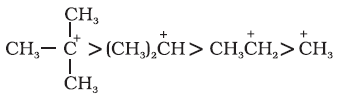
We also observe that the hyperconjugation stabilizes the carbocation as it helps in the dispersal of positive charge. Thus, we can say that greater the number of alkyl groups attached to a positively charged carbon atom, the greater is the hyperconjugation interaction and stabilization of the carbonation.The relative stability on the basis of hyperconjugation is given as,
Hyperconjugation stability

Monday, April 20, 2020

BROWNIAN MOTION

What is Brownian Motion?

“Brownian motion refers to the random movement displayed by small particles that are suspended in fluids. It is commonly referred to as Brownian movement”. This motion is a result of the collisions of the particles with other fast-moving particles in the fluid.
Brownian motion is named after the Scottish Botanist Robert Brown, who first observed that pollen grains move in random directions when placed in water. An illustration describing the random movement of fluid particles (caused by the collisions between these particles) is provided below.
Brownian Motion
Brownian Movement – Collisions between Particles
A particle changes its path when another particle collides with it. Further collisions cause the particle to follow a random, zig-zag motion. It involves a transfer or exchange of momentum/energy between the particles.

Causes and Effects of Brownian Motion

Brownian motion describes randomness and chaos. It is one of the simplest models of randomness. The various causes and effects of this motion are listed in this subsection.

1. What Causes Brownian Motion?

  • The size of the particles is inversely proportional to the speed of the motion, i.e. Small particles exhibit faster movements.
  • This is because the transfer of momentum is inversely proportional to the mass of the particles. Lighter particles obtain greater speeds from collisions.
  • The speed of the Brownian motion is inversely proportional to the viscosity of the fluid. The lower the viscosity of the fluid, the faster the Brownian movement.
  • Viscosity is a quantity that expresses the magnitude of the internal friction in a liquid. It is the measure of the fluid’s resistance to flow.

2. Effects of Brownian Motion

  • Brownian movement causes the particles in a fluid to be in constant motion.
  • This prevents particles from settling down, leading to the stability of colloidal solutions.
  • A true solution can be distinguished from a colloid with the help of this motion.
Albert Einstein’s paper on Brownian motion was vital evidence on the existence of atoms and molecules. The kinetic theory of gases which explains the pressure, temperature and volume of gases is based on the Brownian motion model of particles. To learn more about this topic and other related topics, such as entropy.

Sunday, April 19, 2020

ENANTIOMERS

ENANTIOMERS :-

In chemistry, an enantiomer is one of two stereoisomers that are mirror images of each other that are non-superposable (not identical), much as one's left and right hands are mirror images of each other that cannot appear identical simply by reorientation. A single chiral atom or similar structural feature in a compound causes that compound to have two possible structures which are non-superposable, each a mirror image of the other. Each member of the pair is termed an enantiomorph (enantio = opposite; morph = form) ; the structural property is termed enantiomerism. The presence of multiple chiral features in a given compound increases the number of geometric forms possible, though there may still be some perfect-mirror-image pairs.

A sample of a chemical is considered enantiopure (also termed enantiomerically pure) when it has, within the limits of detection, molecules of only one chirality.

When present in a symmetric environment, enantiomers have identical chemical and physical properties except for their ability to rotate plane-polarized light (+/−) by equal amounts but in opposite directions (although the polarized light can be considered an asymmetric medium). Such compounds are therefore described as optically active, with specific terms for each enantiomer based on the direction: a dextrorotatory compound rotates light a clockwise (+) direction whereas a levorotatory compound rotates light in a counter-clockwise (–) direction.

 A mixture of equal number of both enantiomers is called a racemic mixture or a racemate. In a racemic mixture, the amount of positive rotation is exactly counteracted by the equal amount of negative rotation, so the net rotation is zero (the mixture is not optically active). For all intents and purposes, pairs of enantiomers have the same Gibbs free energy.

 However, theoretical physics predicts that due to parity violation of the weak nuclear force (the only force in nature that can "tell left from right"), there is actually a minute difference in energy between enantiomers (on the order of 10−12 eV or 10−10 kJ/mol or less) due to the weak neutral current mechanism. This difference in energy is far smaller than energy changes caused by even a trivial change in molecular conformation and far too small to measure by current technology, and is therefore chemically inconsequential.

Enantiomer members often have different chemical reactions with other enantiomer substances. Since many biological molecules are enantiomers, there is sometimes a marked difference in the effects of two enantiomers on biological organisms. In drugs, for example, often only one of a drug's enantiomers is responsible for the desired physiological effects, while the other enantiomer is less active, inactive, or sometimes even productive of adverse effects.

 Owing to this discovery, drugs composed of only one enantiomer ("enantiopure") can be developed to make the drug work better and sometimes eliminate some side effects. An example is eszopiclone (Lunesta), which is just a single enantiomer of an older racemic drug called zopiclone. One enantiomer is responsible for all the desired effects, while the other enantiomer seems to be inactive, and the so the dose of eszopiclone is half that of zopiclone.

In chemical synthesis of enantiomeric substances, non-enantiomeric precursors inevitably produce racemic mixtures. In the absence of an effective enantiomeric environment (precursor, chiral catalyst, or kinetic resolution), separation of a racemic mixture into its enantiomeric components is impossible, although certain racemic mixtures spontaneously crystallize in the form of a racemic conglomerate, in which crystals of the enantiomers are physically segregated and may be separated mechanically (e.g., the enantiomers of tartaric acid, whose crystallized enantiomers were separated with tweezers by Pasteur). However, most racemates will crystallize in crystals containing both enantiomers in a 1:1 ratio, arranged in a regular lattice.

Naming conventions

The R/S system is an important nomenclature system used to denote distinct enantiomers. Another system is based on prefix notation for optical activity: (+)- and (−)- or d- and l-. The Latin words for left are laevus and sinister, and the word for right is dexter (or rectus in the sense of correct or virtuous). The English word right is a cognate of rectus. This is the origin of the L/D and S/R notations, and the employment of prefixes levo- and dextro- in common names.

Criterion of enantiomerism

Fischer projection of meso-tartaric acid
An asymmetric carbon atom is one which has bonds with four different atoms or groups, so that these bonds can be arranged in two different ways which are not superposable. Most compounds that contain one or more asymmetric carbon (or other element with a tetrahedral geometry) atoms show enantiomerism, but this is not always true. Compounds that contain two or more asymmetric carbon atoms but have a plane of symmetry with respect to the whole molecule are known as meso compounds.

 A meso compound does not have a mirror image stereoisomer because it is its own mirror image (i.e., it and its mirror image are the same molecule). For instance, meso tartaric acid (shown on the right) has two asymmetric carbon atoms, but it does not exhibit enantiomerism because each of the two halves of the molecule is equal and opposite to the other and thus is superposable on its geometric mirror image. Conversely, there exist forms of chirality that do not require individual asymmetric atoms. 

In fact, there are four distinct types of chirality: central, axial, planar, and helical chirality. Having an enantiomer by virtue of an asymmetric carbon atom represents the most common type of central chirality. The other three types of chirality do not involve asymmetric carbon atoms, and even central chirality does not require the center of chirality to be located at a carbon or any other atom. Consequently, while the presence of an asymmetric carbon atom is a convenient characteristic to look for when determining whether a molecule will have an enantiomer, it is neither sufficient nor necessary as a criterion.

As a rigorous criterion, a molecule is chiral, and will therefore possess an enantiomer, if and only if it belongs to one of the chiral point groups: CnDnTO, and I. However, as a caveat, enantiomers are not necessarily isolable if there is an accessible pathway for racemization at a given temperature and timescale. For example, amines with three distinct substituents are chiral, but with the exception of only a few atypical cases (e.g. substituted N-chloroaziridines), they rapidly planarize and invert ("umbrella inversion") at room temperature, leading to racemization. If the racemization is fast enough, the molecule can often be treated as an achiral, averaged structure.

Examples

Structures of the two enantiomeric forms (S left, R right) of mecoprop
Enantiomers of citalopram. The top is (R)-citalopram and the bottom is (S)-citalopram.
An example of such an enantiomer is the sedative thalidomide, which was sold in a number of countries around the world from 1957 until 1961. It was withdrawn from the market when it was found to cause birth defects. One enantiomer caused the desirable sedative effects, while the other, unavoidably present in equal quantities, caused birth defects.
The herbicide mecoprop is a racemic mixture, with the (R)-(+)-enantiomer ("Mecoprop-P", "Duplosan KV") possessing the herbicidal activity.
Another example is the antidepressant drugs escitalopram and citalopram. Citalopram is a racemate [1:1 mixture of (S)-citalopram and (R)-citalopram]; escitalopram [(S)-citalopram] is a pure enantiomer. The dosages for escitalopram are typically 1/2 of those for citalopram.

Enantioselective preparations

There are two main strategies for the preparation of enantiopure compounds. The first is known as chiral resolution. This method involves preparing the compound in racemic form, and separating it into its isomers. In his pioneering work, Louis Pasteur was able to isolate the isomers of tartaric acid because they crystallize from solution as crystals each with a different symmetry. A less common method is by enantiomer self-disproportionation.

The second strategy is asymmetric synthesis: the use of various techniques to prepare the desired compound in high enantiomeric excess. Techniques encompassed include the use of chiral starting materials (chiral pool synthesis), the use of chiral auxiliaries and chiral catalysts, and the application of asymmetric induction. The use of enzymes (biocatalysis) may also produce the desired compound.
Enantioconvergent synthesis is the synthesis of one enantiomer from a racemic precursor molecule 
utilizing both enantiomers. Thus, the two enantiomers of the reactant produce a single enantiomer of product.

Enantiopure medications

Advances in industrial chemical processes have made it economic for pharmaceutical manufacturers to take drugs that were originally marketed as a racemic mixture and market the individual enantiomers. In some cases, the enantiomers have genuinely different effects. In other cases, there may be no clinical benefit to the patient.

 In some jurisdictions, single-enantiomer drugs are separately patentable from the racemic mixture. It is possible that only one of the enantiomers is active. Or, it may be that both are active, in which case separating the mixture has no objective benefits, but extends the drug's patentability.

Quasi-enantiomers

Quasi-enantiomers are molecular species that are not strictly enantiomers, but behave as if they are. Quasi-enantiomers have applications in parallel kinetic resolution.

BIOMOLECULES CHEMISTRY CLASS 12

                           BIOMOLECULES ( CHEMISTRY )        Carbohydrates:  Polyhydroxy aldehydes or polyhydroxy ketones or compounds on hy...