Showing posts with label ALCOHOLS CLASS 12. Show all posts

Sunday, April 19, 2020

PHYSICAL PROPERTIES OF ALCOHOLS

Physical and Chemical Properties of Alcohols

What are Properties of Alcohol?

Alcohols are organic compounds in which a hydrogen atom of an aliphatic carbon is replaced with a hydroxyl group. Thus an alcohol molecule consists of two parts; one containing the alkyl group and the other containing functional group hydroxyl group. They have a sweet odour. They exhibit a unique set of physical and chemical properties.
The physical and chemical properties of alcohols are mainly due to the presence of hydroxyl group.

Physical Properties of Alcohol

1. The Boiling Point of Alcohols

Alcohols generally have higher boiling points in comparison to other hydrocarbons having equal molecular masses. This is due to the presence of intermolecular hydrogen bonding between hydroxyl groups of alcohol molecules. In general, the boiling point of alcohols increases with an increase in the number of carbon atoms in the aliphatic carbon chain. On the other hand, the boiling point decreases with an increase in branching in aliphatic carbon chains the Van der Waals forces decreases with a decrease in surface area. Thus primary alcohols have a higher boiling point.

2. Solubility of Alcohols

The solubility of alcohol in water is governed by the hydroxyl group present. The hydroxyl group in alcohol is involved in the formation of intermolecular hydrogen bonding. Thus, hydrogen bonds are formed between water and alcohol molecules which make alcohol soluble in water. However, the alkyl group attached to the hydroxyl group is hydrophobic in nature. Thus, the solubility of alcohol decreases with the increase in the size of the alkyl group.

3. The Acidity of Alcohols

Alcohols react with active metals such as sodium, potassium etc. to form the corresponding alkoxide. These reactions of alcohols indicate their acidic nature. The acidic nature of alcohol is due to the polarity of –OH bond. The acidity of alcohols decreases when an electron-donating group is attached to the hydroxyl group as it increases the electron density on the oxygen atom. Thus, primary alcohols are generally more acidic than secondary and tertiary alcohols. Due to the presence of unshared electrons on the oxygen atom, alcohols act as Bronsted bases too.

Chemical Properties of Alcohols

Alcohols exhibit a wide range of spontaneous chemical reactions due to the cleavage of the C-O bond and O-H bond. Some prominent chemical reactions of alcohols are:

1. Oxidation of Alcohol

  • Alcohols undergo oxidation in the presence of an oxidizing agent to produce aldehydes and ketones which upon further oxidation give carboxylic acids.
chemical properties of alcohols
Alcohols: Physical and Chemical Properties

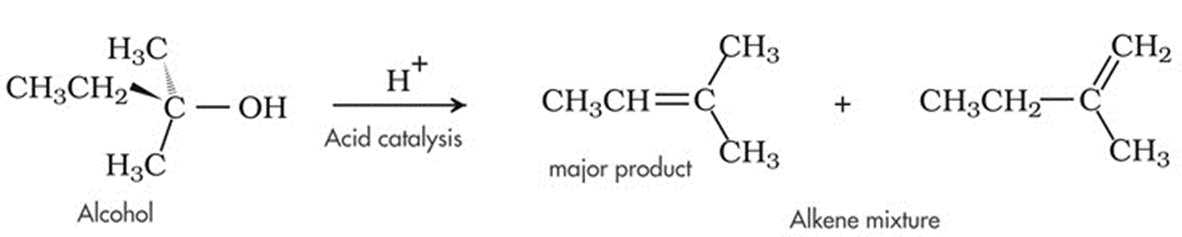
2. Dehydration of Alcohol

  • Upon treatment with protic acids, alcohols undergo dehydration (removal of a molecule of water) to form alkenes. Dehydration of alcohol
chemical properties of alcohols

COMMERCIALLY IMPORTANT ALCOHOLS

Alcoholic Compounds

There are many alcoholic compounds that are very useful in industries and day to day life. Let’s see what these compounds are.

Methanol

Originally, methanol needed the burning of wood chips in the presence of absolutely no air. In this process, few carbohydrates of wood broke to give methanol vapours. These need condensation to give the liquid form. That is why we also know it as wood alcohol.
Commercially, we can synthesise methanol by a catalytic reaction of carbon monoxide (CO) with hydrogen gas (H2) under high temperature and pressure. We generate this mixture of carbon monoxide and hydrogen by the partial burning of coal in the presence of water. By carefully regulating the amount of water added, we can get the correct ratio of carbon monoxide to hydrogen.

Properties of Methanol

  • Methanol has excellent properties as a polar organic solvent.
  • It finds a common use as an industrial solvent.
  • It is more toxic than ethanol. You must know that it could cause blindness or death if you inhale or ingest it in large amounts.
  • Methanol has a high octane rating and a low emission of pollutants. This makes it ideal for many vehicles.
Some commercially important alcohols

Ethanol

Ethanol or ethyl alcohol is common since old times.  People produced it by the fermentation of fruit juices. They stored the fermented juice in a sealed container to drink throughout the winter.
Many different compounds can provide the sugars and starches that break down into simpler compounds during fermentation. Ethanol is also famous as the ‘grain alcohol’ because it is often made from grains, such as corn (maize), wheat, rye, and barley.
We first boil the grain in water to produce the mash. This is then incubated with malt (sprouted barley) to yield the wort. Malt provides an enzyme (diastase) that converts starches in the grain to the sugar maltose. We then incubate the wort with brewer’s yeast, which secretes the enzyme maltase to convert maltose to glucose.
It also gives the enzyme zymase to convert glucose to ethanol. Two of the six carbon atoms in glucose oxidise to give carbon dioxide (CO2); this oxidation provides energy to the yeast cells.
alcoholic
Fermentation yields a solution that is only about 12–15 percent alcohol because higher concentrations are toxic to the yeast cells. We can distil this solution to raise the ethanol content to as high as 95 percent. Fermentation is a relatively expensive method of making ethanol. Industrially, therefore, we produce ethanol by the high-temperature catalytic addition of water to ethylene (C2H4).
alcoholic

Application of Ethanol

Ethanol is an excellent motor fuel with a high octane rating and low emission. However, we can use it as a fuel in peculiar systems that withstand the alcohol’s tendency to dissolve plastic parts. We can use solutions of 10 percent ethanol in gasoline (gasohol) in most cars without any adjustments. Today, ethanol fuels are typically made from natural products, such as corn or sugar.

Isopropyl Alcohol

We produce Isopropyl alcohol (2-propanol) by the indirect hydration of propylene(CH2CHCH3). It finds a common use in industries asana industrial solvent and as a rubbing alcohol that we apply to the skin. Although isopropyl alcohol is more toxic than ethanol, it has less of a drying effect on the skin.alcoholic

Ethylene glycol

The name ‘ethylene glycol’ literally means “the glycol made from ethylene”. Its systematic name is ethane-1,2-diol. We use ethylene glycol commonly as an automotive antifreeze and as an ingredient in hydraulic fluids, printing inks, and paint solvents. We also use it as a reagent in making polyesters, explosives, alkyd resins, and synthetic waxes.

Glycerol

Glycerol (also called glycerine) is a sweet syrupy substance with three alcoholic hydroxyl groups. Its systematic name is propane-1,2,3-triol. The first time, chemists were able to obtain Glycerol as a by-product of soap manufacture, through the saponification (hydrolysis in the base) of fats.
We can obtain about 25 kg (60 pounds) of glycerol with each ton of soap. We can also get it by fermentation from molasses and sugar. During World War II, large quantities of glycerol were needed for the production of glyceryl trinitrate (nitroglycerin); this need was met by synthetic glycerol made from propylene, CH2=CH−CH3.
 We can use glycerol for making nitroglycerin, which is the primary explosive in dynamite and blasting gelatin. Nitroglycerin is also common as a coronary vasodilator (a drug that relaxes and expands blood vessels) for symptomatic relief of chest pain caused by poor circulation to the heart.

Glycerol also finds use as a solvent, moisturizing agent, plasticizer, antifreeze, and water-soluble lubricant. We can find it in a wide variety of products, including foods, soaps, cosmetics, printing inks, hydraulic fluids, and pharmaceuticals.

REACTIONS OF ALCOHOLS

Reactions of Alcohols

Alcohols are capable of being converted to metal salts, alkyl halides, esters, aldehydes, ketones, and carboxylic acids.
Alcohols are only slightly weaker acids than water, with a K a value of approximately 1 × 10 −16. The reaction of ethanol with sodium metal (a base) produces sodium ethoxide and hydrogen gas.
This reaction is identical to the reaction of sodium metal with water.
However, the latter reaction occurs faster because of the increased acidity of water (K a value of 1 × 10 −15). Likewise, similar reactions occur with potassium metal.
The acidity of alcohols decreases while going from primary to secondary to tertiary. This decrease in acidity is due to two factors: an increase of electron density on the oxygen atom of the more highly‐substituted alcohol, and steric hindrance (because of the alkyl groups, which inhibit solvation of the resulting alkoxide ion). Both of these situations increase the activation energy for proton removal.
The basicity of alkoxide ions increases while going from primary to tertiary. This increase in basicity occurs because the conjugate base of a weak acid is strong. The weaker the acid, the stronger the conjugate base.
Alcohols are converted to alkyl halides by S N1 and S N2 reactions with halogen acids.
Primary alcohols favor S N2 substitutions while S N1 substitutions occur mainly with tertiary alcohols.
A more efficient method of preparing alkyl halides from alcohols involves reactions with thionyl chloride (SOCl 2).
This reaction is rapid and produces few side reaction products. In addition, the sulfur dioxide and hydrogen chloride formed as byproducts are gasses and therefore easily removed from the reaction. Mechanistically, the alcohol initially reacts to form an inorganic ester.
The chloride ion produced by this reaction, acting as a nucleophile, attacks the ester in an S N2 fashion to yield molecules of sulfur dioxide, hydrogen chloride, and an alkyl halide.
Because the reaction proceeds mainly by an S N2 mechanism, the alkyl halide produced from an optically active alcohol will have the opposite relative configuration from the alcohol from which it was formed.
Because thionyl bromide is relatively unstable, alkyl bromides are normally prepared by reacting the alcohol with phosphorous tribromide (PBr 3).
This reaction proceeds via a two‐step mechanism. In the first step, the alcohol reacts with the phosphorous tribromide.
The second step is an S N1 or S N2 substitution in which the bromide ion displaces the dibromophosphorous group.
In a similar manner, alkyl iodides are prepared by reacting an alcohol with phosphorous triiodide.

Ester formation

Esters are compounds that are commonly formed by the reaction of oxygen‐containing acids with alcohols. The ester functional group is the
  
Alcohols can be converted to esters by means of the Fischer Esterification Process. In this method, an alcohol is reacted with a carboxylic acid in the presence of an inorganic acid catalyst.
Because the reaction is an equilibrium reaction, in order to receive a good yield, one of the products must be removed as it forms. Doing this drives the equilibrium to the product side.
The mechanism for this type of reaction takes place in seven steps:
1. The mechanism begins with the protonation of the acetic acid.
2. The Ï€ electrons of the carboxyl group, , migrate to pick up the positive charge.
3. The oxygen of the alcohol molecule attacks the carbocation.
4. The oxonium ion that forms loses a proton.
5. One of the hydroxyl groups is protonated to form an oxonium ion.
6. An unshared pair of electrons on another hydroxy group reestablishes the carbonyl group, with the loss of a water molecule.
7. The oxonium ion loses a proton, which leads to the production of the ester.
Alkyl sulfonate formation. Alcohols may be converted to alkyl sulfonates, which are sulfonic acid esters. These esters are formed by reacting an alcohol with an appropriate sulfonic acid. For example, methyl tosylate, a typical sulfonate, is formed by reacting methyl alcohol with tosyl chloride.
Other sulfonyl halides that form alkyl sulfonates include:
These groups are much better leaving groups than the hydroxy group because they are resonance stabilized. Alcohol molecules that are going to be reacted by S N1 or S N2 mechanisms are often first converted to their sulfonate esters to improve both the rate and yield of the reactions.
Formation of aldehydes and ketones. The oxidation of alcohols can lead to the formation of aldehydes and ketones. Aldehydes are formed from primary alcohols, while ketones are formed from secondary alcohols.
Because you can easily further oxidize aldehydes to carboxylic acids, you can only employ mild oxidizing agents and conditions in the formation of aldehydes. Typical mild oxidizing agents include manganese dioxide (MnO 2), Sarett‐Collins reagent (CrO 3—(C 5H 5N) 2), and pyridinium chlorochromate (PCC),
Following are several examples of the oxidation of primary alcohols:
Because ketones are more resistant to further oxidation than aldehydes, you may employ stronger oxidizing agents and higher temperatures. Secondary alcohols are normally converted to ketones by reaction with potassium dichromate (K 2Cr 2O 7), potassium permanganate (KMnO 4), or chromium trioxide in acetic acid (CrO 3/CH 3COOH). Following are several examples of the oxidation of secondary alcohols:
Carboxylic acid formation. Upon oxidation with strong oxidizing agents and high temperatures, primary alcohols completely oxidize to form carboxylic acids. The common oxidizing agents used for these conversions are concentrated potassium permanganate or concentrated potassium dichromate. Following are several examples of this type of oxidation:

OXYMERCURATION-DEMURCURATION REACTION

Oxymercuration-Demercuration of Alkenes
alkene alkoxymercuration-demercuration to give an alcohol

Summary
  • Overall transformation C=C to H-C-C-OH
  • This is an alternative method for hydrating alkenes to give alcohols
  • Typical reagents are Hg2+ salts such as mercury acetate, Hg(OAc)2, in aqueous THF
  • Unfortunately, mercury compounds are generally quite toxic
  • Regioselectivity predicted by Markovnikov's rule (major product is the more highly substituted alcohol)
  • The reaction is not stereoselective
  • Reaction proceeds via the formation of a cyclic mercurinium ion (compare with bromination of alkenes)
a mercurinium ion
  • The mercurinium ion is opened by the attack of water to complete the oxymercuration.
  • When the water attacks, it does so at the more highly substituted carbon.
  • Demercuration is effected by a reduction using sodium borohydride, NaBH4
  • If the reaction is carried out in the presence of an alcohol rather than water, then ethers are obtained via an alkoxymercuration :
alkoxymercuration-demercuration to give an ether
  • The only difference here is a change in the nucleophile from H2O to ROH

Related reactions
MECHANISM FOR REACTION OF ALKENES WITH Hg(OAc)2 / H2O
Step 1:
The C=C Ï€ electrons act as the nucleophile with the electrophilic Hg and loss of an acetate ion as a leaving group, forming the cyclic mercurinium ion.
oxymercuration / demercuration of C=C
Step 2:
Water functions as a nucleophile and attacks one of the carbons substituted with mercury resulting in cleavage of the C-Hg bond.
Step 3:
The acetate ion functions as a base deprotonating the oxonium ion to give the alcohol. This completes the oxymercuration part of the reaction.
Step 4:(mechanism not shown)
The hydride reduces the Hg off, creating a C-H bond while breaking the C-Hg bond. This is the demercuration part of the process. This step is not stereoselective.

ALCOHOL PREPARATION METHODS

Hydrolysis of Alkyl Halides

This is a nucleophilic  substitution reaction.
 R-X + KOHaq → R-OH
The method is not satisfactory as olefins are also formed as by-products. However better yields is obtained by using moist Ag2O or aqueous K2CO3. Tertiary butyl halides mainly gives alkene due to dehydrohalogenation. 

Hydration of Alkenes

This is electrophilic addition of H2O to alkenes.
  
Mechanism of Hydration of alkenes:
Protonation of alkene to form carbocation by electrophilic
Nucleophilic attack of water on carbocation.
Deprotonation to form an alcohol.
Except ethyl alcohol no other primary alcohol can be obtained by this method, however hydroboration of terminal alkenes give primary alcohols.

Oxymercuration and Demercuration of Alkanes

Alkenes react with mercuric acetate in presence of H2O and tetra hydrofuran to give alkyl mercury compounds.
Examples:

Hydroboration Oxidation


From Grignard Reagents

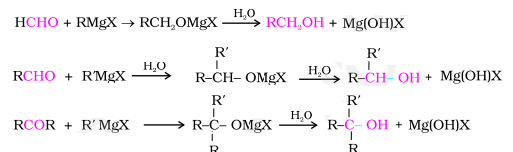
All the three types of monohydric alcohols (primary, secondary and tertiary alcohols) are obtained by the use of Grignard reagents and carbonyl compounds. The addition of RMgX on carbonyl compounds followed with hydrolysis yields alcohols.
   
The Grignard reagent : an organometallic compound
When a solution of an alkyl halide in dry ethyl ether, (C2H5)O, is allowed to stand over turnings of metallic magnesium a vigorous reaction takes place: the solution turns cloudy, begins to boil, and the magnesium metal gradually disappears. The resulting solution is known as a Grignard reagent, after Victor Grignard (of the University of Lyons) who received the Nobel prize in 1912 for its discovery. It is one of the most useful and versatile reagents known to the organic chemist.
CH3I + Mg  \overset{Ether}{\rightarrow} CH3MgI
H3CH2Br + Mg  \overset{Ether}{\rightarrow} CH3CH2MgBr
Ethyl bromide                Ethylmagnesium bromide
The Grignard reagent has the general formula R MgX, and the general name alkylmagnesium halide. The carbon-magnesium bond is covalent but highly polar, with carbon pulling electrons from electropositive magnesium; the magnesium halogen bond is essentially ionic. R-Mg+X
Since magnesium becomes bonded to the same carbon that previously held halogen, the alkyl group remains intact during the preparation of the reagent. Thus n-propyl chloride yields n­-propylmagnesium chloride, and isopropyl chloride yields isopropylmagnesium chloride.
CH3CH2CH2Cl + Mg   \overset{Ether}{\rightarrow} CH3CH2CH2MgCl
 n-Propyl chloride                     n-Propylmagnesium chloride
CH3CHClCH3 + Mg   \overset{Ether}{\rightarrow}  CH3CHMgClCH3
 Isopropyl chloride               Isopropylmagnesium chloride
The Grignard reagent is the best-known member of a broad class of substances, called organometallic compounds, in which carbon is bonded to a metal: lithium potassium, sodium, zinc, mercury, lead, thallium-almost any metal known. Each kind of organometallic compound has, of course, its own set of properties, and its particular uses depend on these. But whatever the metal, it is less elctronegative than carbon, and the carbon-metal bond-like one in the Grignard reagent - is highly polar. Although the organic group is not a full-fledged carbanion–an anion in which carbon carries negative charge–it nevertheless has considerable carbanion character. As we shall see, organometallic compounds owe their enormous usefulness chiefly to one common quality: they can serve as a source from which carbon is readily transferred with its electrons.
The Grignard reagent is highly reactive. It reacts with numerous inorganic compounds including water, carbon dioxide, and oxygen, and with most kinds of organic compounds; in many of these cases the reaction provides the best way to make a particular class of organic compounds.
The reaction with water to form an alkane is typical of the behaviour of the Grignard reagent–and many of the more reactive organometallic compounds–toward acids. In view of the marked carbanion character of the alkyl group, we may consider the Grignard reagent to be the magnesium salt, R MgX, of the extremely weak acid,
R–H. The reaction 
R MgX + HOH   → R–H   +  Mg(OH)X
            Stronger       Weaker
                acid            acid
is simply the displacement of the weaker acid, R–H, from its salt by the stronger acid, HOH.
R MgX + NH3  →  R–H + Mg(NH2)X
           Stronger    Weaker
             acid        acid
An alkane is such a weak acid that it is displaced from the Grignard reagent by compounds that we might ordinarily consider to be very weak acids themselves, or possibly not acids at all. Any compound containing hydrogen attached to oxygen or nitrogen is tremendously more acidic than an alkane, and therefore can decompose the Grignard reagent: for example, ammonia or methyl alcohol.
RMgX + CH3OH  →  R–H + Mg(OCH3)X
            Stronger       Weaker
             acid            acid

Grignard Synthesis of Alcohols

The Grignard reagent, we recall, has the formula RMgX, and is prepared by the reaction of metallic magnesium with the appropriate organic halide. This halide can be alkyl (1o, 2o, 3o), allylic, aryl alkyl (e.g., benzyl), or aryl (phenyl) or substituted phenyl. The halogen may be –Cl, –Br or –I, (Arylmagnesium chlorides must be made in the cyclic ether tetrahydrofuran instead of ethyl ether.)
Aldehydes and ketones resemble each other closely in most of their reactions. Like the carbon-carbon double bond, the carbonyl group is unsaturated, and like the carbon-carbon bond, it undergoes addition. One of its typical reactions is addition of the Grignard reagent.
Since the electrons of the carbonyl double bond hold together atoms of quite different electronegativity, we would not expect the electrons to be equally shared; in particular, the mobile p cloud should be pulled strongly towards the more electronegative atom, oxygen. Whatever the mechanism involved, addition of an unsymmetrical reagent is oriented so that the nucleophilic (basic) portion attaches itself to carbon, and the electrophilic (acidic) portion attaches itself to oxygen.
The carbon-magnesium bond of the Grignard reagent is a highly polar bond, carbon being negative relative to electropositive magnesium. It is not surprising, then, that in the addition to carbonyl compounds, the organic group becomes attached to carbon and magnesium to oxygen. The product is the magnesium
salt of the weakly acidic alcohol and is easily converted into the alcohol itself  by the addition of the stronger acid, water. Since the Mg(OH)X thus formed is a gelatinous material difficult to handle, dilute mineral acid (HCl, H2SO4) is commonly used instead of water, so that water-soluble magnesium salts are formed.

Products of the Grignard Synthesis

The class of alcohol that is obtained from a Grignard synthesis depends upon the type of carbonyl compoud used: formaldehyde, HCHO, yields primary alcohols; other aldehydes, RCHO, yield secondary alcohols; and ketones, R2CO, yield tertiary alcohols.
This relationship arises directly from our definitions of aldehydes and ketones, and our definitions of primary, secondary, and tertiary alcohols. The number of hydrogens attached to the carbonyl carbon defines the carbonyl compound as formaldehyde, higher aldehyde or ketone. The carbonyl carbon is the one that finally bears the –OH group in the product; here the number of hydrogen defines the alcohol as primary, secondary, or tertiary.
For example:
A related synthesis utilized ethylene oxide to make primary alcohols containing two more carbons than the Grignard reagent. 
Here, too, the organic group becomes attached to carbon and magnesium to oxygen, this time with the breaking of a carbon-oxygen s bond in the highly strained three-membered ring. For example:

Reduction of Carbonyl Compounds

Aldehydes can be reduced to primary alcohols, and ketones to secondary alcohols, either by catalytic hydrogenation or by use of chemical reducing agents like lithium aluminum hydride, LiAlH4. Such reduction is useful for the preparation of certain alcohols that are less available than the corresponding carbonyl compounds, in particular carbonyl compounds that can be obtained by the aldol condensation. For example
Reduction of ketones gives secondary alcohol.
Note : tertiary alcohols can be obtained by this method. 
Sodium borohydride, NaBH4, does not reduce carbon-carbon double bonds, not even those conjugated with carbonyl groups, and in thus useful for the reduction of such unsaturated carbonyl compounds to unsaturated alcohols.Let us look a little more closely at reduction by metal hydrides. Alcohols are formed from carbonyl compounds, smoothly and in high yield, by the action of such compounds as lithium aluminum hydride, LiAlH4. Here again, we see
Nucleophilic addition : this time the nucleophile is hydrogen transferred with a pair of electrons-as a hydride ion, H:-  –from the metal to carbonyl carbon:
Reduction of acids to alcohols: Lithium aluminum hydride, LiAlH4, is one of the few reagents that can reduce an acid to an alcohol; the inital product is an alkoxide from which the alcohol is liberated by hydrolysis:
4RCOOH + 3LiAlH4 → 4RCH2OH              1oalcohol
Because of the excellent yields it gives, LiAlH4 is widely used in the laboratory for the reduction of not only acids but many other classes of compounds. As an alternative to direct reduction, acids are often converted into alcohols by a two-step process: esterification, and reduction of the ester.
Reduction of esters: Like many organic compounds, esters can be reduced in two ways: (A) by catalytic hydrogenation using molecular hydrogen, or (B) chemical reduction. In either case, the ester is cleaved to yield (in addition to the alcohol or phenol from which it was derived) a primary alcohol corresponding to the acid portion of the ester.
RCOOR'  \overset{Reduction}{\rightarrow}  RCH2OH + R'OH
Ester                       1o alcohol
Hydrogenolysis (cleavage by hydrogen) of an ester requires more severe conditions than simple hydrogenation of (addition of hydrogen to) a carbon-carbon double bond. High pressures and elevated temperatures are required: the catalyst used most often is a mixture of oxides known as copper chromite, of approximately the composition CuO.CuCr2O4. For example:
CH3(CH2)10COOCH3  \xrightarrow[H_2 , CuO.CuCr_2O_4]{150o, 5000 lb/in.2}  CH3(CH2)10CH2OH + CH3OH
(Methyl dodecanoate)                                (1-Dodecanol)
Chemical reduction is carried out by use of sodium metal and alcohol, or more usually by use of lithium aluminium hydride
By the reduction of acids and their derivatives :
RCOOH     reduction-of-acids               RCH2OH
(RCO2)O           as-above            RCH2OH
RCOCI             as-above                  RCH2OH
RCOOR'           as-above             RCH2OH + R'OH
Note : If C2H5OH + Na is used as reducing agent, the reduction is known as Bouveault-Blane reaction.
By the action of nitrous acid on primary amines :
R-NH2 + HNO2 → R-OH + N2 + H2O
However under similar conditions CH3NH2 gives CH3-O-N=O or CH3OCH3
CH3NH2 + 2HNO2 → CH3-O-N=O + 2H2O + N2
or  2CH3NH2 + 2HNO2 → CH3OCH3 + 2N2 + 3H2O 
Preparation of Methanol: Methanol can also be prepared as
methanol-can-also-be-prepared  

Hydroxylation of Alkenes

BIOMOLECULES CHEMISTRY CLASS 12

                           BIOMOLECULES ( CHEMISTRY )        Carbohydrates:  Polyhydroxy aldehydes or polyhydroxy ketones or compounds on hy...